
2026 Pennsylvania Dutch Calendar
Sie hot die Schtanne gemollt, als sie eemol waare
She Painted the Stars As They Once Were
The Barn Star Paintings of Frances Barr Kremp (1899-1972)
(28pp. full-color illus. Masthof Press, 2025.)


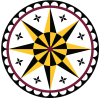
This year’s calendar features the barn star paintings of Frances W. Barr Kremp (1899-1972), a public school teacher in Reading, Pa. For over thirty years she documented different barn stars primarily in Berks and Lehigh Counties through watercolor and sketch mediums. Kremp helped to preserve the artistic legacy of the stars in the region and their connection to the local culture. As a bilingual calendar, all of the text is in Pennsylvania Dutch and English for ease of use in families that wish to explore their Pennsylvania heritage.
(28pp. full-color illus. Masthof Press, 2025.)
To order the calendar online, visit: https://www.masthof.com or download a printable order form.
Frances W. Barr Kremp (1899-1972) was a public school teacher in Reading, Pennsylvania, who studied at the Pennsylvania Museum School of Industrial Art (later named the Philadelphia Museum College of Art). Over the course of roughly thirty years, Kremp documented around forty-five different barn stars primarily from Berks and Lehigh through watercolor and sketch mediums. Kremp helped to preserve the artistic legacy of the stars in the region and their connection to the local culture. These paintings and sketches were later featured in educational exhibitions at the Landis Valley Museum and the William Penn Memorial Museum showcasing the diversity of the region’s distinctive star patterns, and the history of the artistic tradition. Only a year before these exhibitions introduced her work to the Pennsylvania Dutch community and the public, Frances Barr Kremp passed away on April 8, 1972. Her paintings are preserved as part of the museum collection at the Pennsylvania German Cultural Heritage Center at Kutztown University.
Explore more works of art, photographs, and sketches by Frances Barr Kremp in an online exhibition at www.pagerman.org/frances-barr-kremp.
The Pennsylvania Dutch language, Pennsylvaanisch Deitsch, is the native speech of thousands of inhabitants of Pennsylvania and twenty-nine other U.S. states, as well as Ontario. In the 18th century, some 81,000 immigrants from German-speaking regions, including southwestern Germany, Alsace, and Switzerland, came to Pennsylvania and settled in rural Southeastern Pennsylvania. By 1800, the descendants of these immigrants spoke Pennsylvania Dutch, which still preserves a strongly southwestern (specifically, Palatine) German character, even after 300 years in North America.
The Pennsylvania Dutch language is a cultural treasure. Within its idioms, expressions, and figures of speech, a vast repository of cultural memory spanning many generations is still accessible today. This calendar, with its annual observations of seasons, secular holidays, and religious feast-days, is an excellent way to relate to the culture of the region, both past and present. Throughout the history of Pennsylvania Dutch, the language was spoken by two main groups of people, the Church People, composed of mostly Lutheran and Reformed churches, and the Plain people, members of conservative Anabaptist and Pietist sects. Although everyday use of Pennsylvania Dutch has declined among the descendants of the Church People, the number of Amish and Old Order Mennonite speakers of the language is doubling every twenty years. Today there is a resurgence in interest in traditional culture of the Pennsylvania Dutch, and many communities, organizations, and institutions have taken an interest in the preservation and continuation of the language.