Currently on display in the Delight E. Breidegam Building, Headquarters of the Pennsylvania German Cultural Heritage Center, 15155 Kutztown Road, Kutztown, PA 19530. Hours Monday-Friday 10am-12pm & 1pm-4pm.
Transatlantic Botanical Traditions Among the Pennsylvania Dutch
June 28, 2025 – February 28, 2026 in the Main Exhibition Gallery, Delight E. Breidegam Building.
Influenced by transatlantic immigration, herbal medicine flourished in early Pennsylvania, where over 81,000 German-speaking immigrants arrived prior to the American Revolution, bringing with them their vibrant healing traditions and illustrated herbal compendiums. From this diaspora, America’s first book of botanical medicine was published by printer and apothecary Christoph Saur Jr. between 1762 and 1778, inspiring the use of herbal medicine on a folk-cultural level for many generations to come.
Astronomer, Printmaker, and Polymath of Mount Penn
February 28, 2024 – February 28, 2026 in the M.L.E. Foundation Gallery.
Carl Friederich Egelmann (1782-1860) of Reading, Berks County, was the foremost astronomical calculator of nineteenth-century America. For over 40 years, Egelmann’s tables and engravings of the movements of the heavenly bodies were featured in annual farmer’s almanacs throughout Pennsylvania and the Mid-Atlantic, enhancing the influence of astronomy on the region’s art, agriculture, and folk-cultural traditions.
Selected Works of Marshall D. Rumbaugh (1948-2023)
June 29, 2024 – May 20, 2025
Exploring the life and work of contemporary Pennsylvania sculptor, Marshall D. Rumbaugh (1948-2023), Carved from Our Roots features artistic works in wood and stone inspired by the folk art traditions of the Pennsylvania Dutch. Blending his love of Pennsylvania Dutch folk art with his formal training in modern and traditional sculpture, Marshall D. Rumbaugh carved a diverse range of figural, geometric, and functional works of art that explored his roots as a native of Northeastern Pennsylvania. Through his iconic figures, dynamic composition, and devoted attention to detail, Marshall’s works embody his sacred and contemporary influences, depicting the folk-cultural stories of American communities with reverence and humanity.
Der Alt Dengelschtock – The Old Sharpening Anvil
Precision, Frugality & Cooperation in Pennsylvania Dutch Agricultural Tradition
November 3, 2023 – June 24, 2024
Exploring the cultural significance and superb craftsmanship of early agricultural technology for the cooperative farming practices of the Pennsylvania Dutch, this exhibition stunning installations of early Pennsylvania Dutch hand tools and their farm contexts, highlighting the cooperative spirit of inter-generational family farming that sustained the region’s culture for centuries.
Online exhibition forthcoming.
The Life and Work of Milton J. Hill (1887-1972)
June 30, 2023 – October 20, 2023
Celebrating the life and work of Berks County barn star artist Milton J. Hill through original works of art, cultural artifacts, and ephemera, this exhibition reveals how a third-generation barn painter from Virginville, Berks County, preserved and transformed traditional barn decoration among the Pennsylvania Dutch. As both an artist and innovator, Milton Hill was best known for producing the most elaborate geometric star patterns found in the region, and his signature barn star design is known as the “Hill Star” today in honor of his unique contributions to the agricultural folk art of the region.
Contemporary Visions of the Sainted Healer
November 16. 2022 – June 24, 2023
This exhibition explores the life and legend of Mountain Mary or Anna Maria Young (1744-1819), the celebrated immigrant pioneer, farmer, and sainted healer of the Oley Valley. Featuring new works by contemporary artists and historic artifacts from the Oley Valley, the exhibition presents Mountain Mary’s colorful and often contradictory legend, which continues to embody the traditions and positive values sustaining the region’s folk culture.
Celestial Images in Pennsylvania Dutch Folk Culture
September 1, 2022 – November 16, 2022
For generations, images of the stars hold an abiding presence in the arts and material culture of the Pennsylvania Dutch. Across domestic, agricultural, and sacred spheres of life, the stars adorn objects of utility, decoration, and inspiration. Living traditions today and folk beliefs of the past suggest that the stars are of special interest to the folk culture of the region, echoing the perennial human fascination with the movements of the heavens. Even as the culture continues to grow and change, the images of the stars have become symbols of the folk culture of the region.
Text, Illumination, & Devotional Imagery in Pennsylvania German Material Texts
September 1, 2022 – February 24, 2024
Pennsylvania Germans led the North American continent in the printing and dissemination of sacred texts and Bibles throughout the 18th and early 19th centuries through the use of sophisticated printing technology. At the same time, the creation of handwritten calligraphic texts flourished as part of a robust literary and devotional tradition. Though produced in a distinctly American context, these works of text and image comprise a portion of a broader story of transatlantic immigration, entrepreneurial engagement, and spiritual diaspora.
Frances W. Barr Kremp (1899-1972) of Reading, Pennsylvania was an art teacher in public schools for thirty-five years. As an ongoing artistic endeavor, Kremp traveled the state of Pennsylvania to document the barn stars of the Pennsylvania Dutch, commonly referred to as Hex Signs in tourist literature. Over the course of roughly thirty years Kremp documented over forty-five different barn stars primarily from Berks and Lehigh counties through watercolor and sketch mediums. These paintings and sketches were featured in exhibitions at the Landis Valley Museum and the William Penn Memorial Museum in the early 1970s. These exhibitions aimed to educate the public on the diversity of the region’s distinctive star patterns, and the history of the artistic tradition.
Devotion and Simplicity of the Plain People Through the Arts of Constantine Kermes (1923-2009)
Constantine “Gus” John Kermes was an artist and designer with a strong love and appreciation for the culture of the Pennsylvania Germans, a cultural group defined by virtues of hard work, discipline, simplicity, and religious devotion. During his career as an artist, Kermes had well over 200 solo exhibits in galleries and museums around the United States. Kermes’s artistic style was noted for its flat color areas and strong linear patterns. His work mainly focused on the Plain People of Pennsylvania, depicting them in simpler forms, like the styles seen in religious icons.
Dorothy Elaine Kalbach was among the earliest members to organize the Reading-Berks Chapter of the Pennsylvania Guild of Craftsmen, and was invited by fellow guild member Olive Zehner to participate for many years at the Kutztown Folk Festival. For around 35 years, Kalbach produced an abundance of creative works including greeting cards, fans, handkerchiefs, table runners, napkins, and more. She often worked with woodblock printing, using a four-color process.
The quilts in the collection of the Pennsylvania German Cultural Heritage Center show a variety of patterns, styles, and functions while spanning a range of dates from the early 1800s to contemporary quilts. Over time, quilting went from a necessity to keep one’s family warm and covered in the colder months, to a form of artistic expression, a way to show off needlework skills and creativity, and a means of socialization. The long process of finishing a quilt required hand-stitching all the layers of the quilt together so that it could be used as a functional blanket, and was usually done in a group that allowed plenty of time for the social reinforcement of community bonds. This group process is reflected in the collection at the Pennsylvania German Cultural Heritage Center.
Paul R. Wieand was a proficient artist, actor, and playwright, best known for his role playing “Sabina” in the audio show Assaba un Sabina that aired from 1944 to 1954. During his life, Paul was hailed as “Mr. Pennsylvania Dutch” by people who knew him. His artworks, Christmas cards, tapestries, and other projects contribute to an extensive legacy that lives on in history.
Supernatural beliefs played a central role in the traditions of the Pennsylvania Dutch, supporting a wide range of expressions in material culture, literature, customs, and ritual applications. This gallery showcases examples of archival materials and artifacts reflecting local interest in legends, protective traditions, and ritual blessings from the Pennsylvania Dutch culture in and around the Berks County area from the eighteenth to the twentieth century.
Scherrenschnitte is a distinctive style of paper cutting dating back as early as the eighteenth century. The Pennsylvania Dutch forms feature repeated motifs of birds and other symbols, as well as other stylistic differences that set it apart from other American paper-cutting styles. Some examples include those made as tokens of affection or valentines that would have been gifted or traded to others. Many were stored in family bibles discovered by subsequent generations as common family expressions of the Pennsylvania Dutch tradition.
The Album of Lizzie Leaman Groff, Preserving Memory, Community, and Social Bonds Through Scrapbooking
Lizzie Leaman Groff collected many die-cut prints and compiled them within this scrapbook, starting in 1882. These prints ranged from fragments, to advertisements and calling cards.
Old Time Pennsylvania Dutch Cooking
Gladys M. Lutz (1909- 2007), often called “the Grandma Moses of the Lehigh Valley,” was a celebrated folk artist and educator. In addition to 36 years as a teacher, she created hundreds of paintings focusing on the daily lives of people in Pennsylvania Dutch country. She would table at libraries, museums, art exhibitions, and craft shows where she would display her art in tandem with presentations intended to share the significance of the scenes and practices featured in her art. This collection of paintings was commissioned by redware potter Jeff Dietrich and included in a collaborative cookbook, Folk Art and Foodways of the Pennsylvania Dutch.
19th Century Foodways: Connected Through Time
This exhibition explores a variety of recipes and culinary artifacts along with translated recipes from the classic cookbook Die Geschickte Hausfrau by J. Martin Lutz and Theodore F. Scheffer, written in German and published in two editions between 1848 and 1851. These culinary artifacts and recipes to show the similarities between present day recipes and recipes of the past.
Wilbur Clifford (W.C.) “Jack” Riley was a history instructor and football coach at the Hill School in Pottstown, Pennsylvania. He coached from 1935 until 1952, when he suffered a heart attack during a game. On Sundays after football games, Riley would drive through the rural landscape of Montgomery, Berks, Lehigh, and Bucks counties with his wife, Helen Herzog Riley, and look for decorated barns. He sketched the barn stars he saw and then painted them as a release from the stress of coaching. The following images represent selections from 50 paintings donated to the Pennsylvania German Cultural Heritage Center by Riley’s grandson, Jack Moyer.
The rich seasonal customs and annual traditions of the Pennsylvania Dutch blend the Old World liturgical calendar with agricultural traditions and folk-cultural expressions. Although many of the major feast-days are universal in Western cultures, much of the character of these celebrations is American and uniquely Pennsylvanian in flavor. Distinctive foodways, decorations, artistic expression, religious blessings, and ritual traditions form a colorful tapestry winding through the annual progression of the year, reflecting the persistence of the Pennsylvania Dutch community’s vernacular language, cultural identity, and folklife.
Pennsylvania Dutch folk culture possesses a wide range of ritual traditions used for practical purposes, such as healing, protection, and assurance of positive outcomes in everyday affairs. Some of these traditions proceed from observations associated with special days in the sacred liturgical calendar, while others are part of a vernacular healing belief system known as powwowing or Braucherei, a Pennsylvania Dutch word for ‘ritual traditions.’
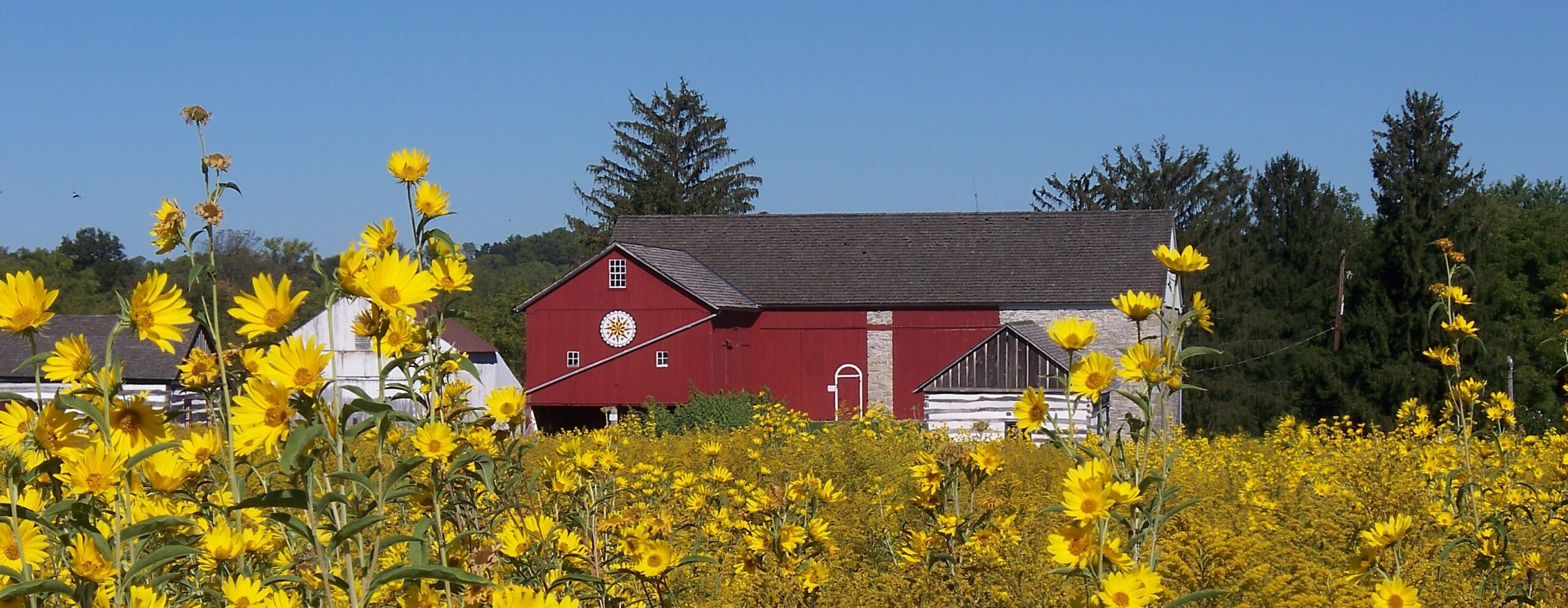
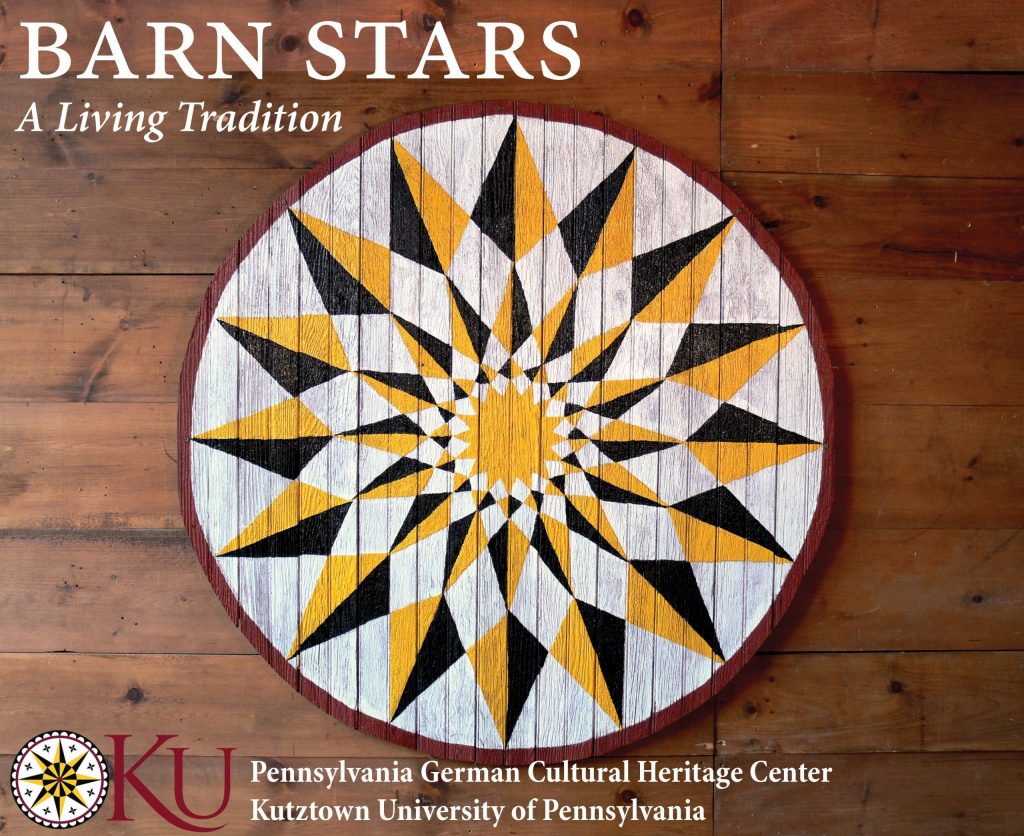
Barn stars (also known as hex signs), are a form of indigenous American folk art. Throughout Southeastern Pennsylvania, and within the cultural hearth of the Pennsylvania Dutch, decorated barns, primarily from the 19th century once saturated the rural landscape in Berks, Lehigh, Bucks, Northampton and Montgomery counties. Featuring geometric paintings of celestial bodies including stars, suns, and moons, these large-scale murals have come to represent the region’s culture and traditional arts.
Pennsylvania led the North American continent in the printing of Bibles throughout the 18th century and into the early 19th century, establishing a culturally significant legacy that sustained religious communities of the past and present, and left an indelible impression on American culture. Following the mass exodus of German-speaking immigrants to the new world, the German Bible was a central feature in the formation of early communities in Pennsylvania, with broader implications as a cultural artifact for American history, genealogy, and material culture, as well as one of the most cherished possessions among the Pennsylvania Dutch.
In the mid-20th century, the Pennsylvania Dutch culture experienced a revitalization of folk traditions, arts, foodways, and vernacular language. Cultural celebrations, such as the Kutztown Folk Festival, provided new opportunities for local people to promote their culture to international audiences of visitors and tourists, and folk artists were among those in the forefront of these efforts. At the same time, the decorated barns of the region were focal points in the cultural landscape which drew national attention. Romanticized and exaggerated accounts in travel literature suggested erroneously that the barn star decorations were intended to protect farms from supernatural forces. Local folk artists, many of whom never painted on barns, began to embrace a playful and contemporary view of geometric motifs used in traditional barn decoration, blending such designs with other organic and curvilinear patterns, and embracing the mythology of the hex sign.
A sampler of the unique material culture of the Pennsylvania Germans, including works of art and historical artifacts in a variety of forms and expressions. The Heritage Center’s cultural collections provide examples of the region’s folk cultural traditions, with examples of early furniture, fiber arts, ironwork, tools, redware pottery, rare books, basketry, and and illuminated manuscripts.